Store Brands Reach 23.5% Unit Share as U.S. Shoppers Keep Trading Down
Store brands continue to win the volume battle in U.S. retail. Data from Circana released by the Private Label Manufacturers Association (PLMA) shows that private label unit sales outperformed national brands for the eight months ending 9 August, extending a pattern that has held for most of the past year.
The headline numbers
Store brand unit sales rose 0.3% year to date, while national brand units fell 0.7%, a spread of one percentage point. PLMA reports that store brands have outperformed national brands on unit growth in every month but one so far in 2026.
Store brand unit share for the period stood at 23.5%, which PLMA describes as an all-time high, while dollar share came in at 21.1%.
The dollar picture is different. Store brand dollar sales rose 0.3%, compared with a 2% increase for national brands, a gap PLMA attributes largely to national brand pricing strategies rather than stronger consumer demand.
Scale of the market
Over the eight-month period, U.S. retail outlets sold 43 billion store brand units against 136 billion national brand units. Store brand dollar sales reached $174 billion, compared with $653 billion for national brands.
By department, General Food led store brand unit volume with 19.9 billion units, followed by Refrigerated (15.2 billion), Beverages (5.1 billion), General Merchandise (4.7 billion) and Frozen (4.6 billion). Refrigerated generated the highest private label dollar volume at $58.7 billion, ahead of General Food ($53.5 billion), General Merchandise ($25.4 billion) and Frozen ($22.7 billion).
Where growth is strongest
Over the 52 weeks to 9 August, Pet Care posted the largest store brand unit improvement at 4.5%, followed by Beverages and Refrigerated, each up 1.8%. In dollar terms, Beverages led with 5% growth, followed by Pet Care (3.4%), Frozen (2.3%) and General Merchandise (2.1%).
Units versus dollars
PLMA has consistently argued that unit sales are the more reliable gauge of shopper preference. In its mid-year update in July, PLMA president Peggy Davies noted that the gap between unit and dollar trends partly reflects volatile national brand pricing, with some brands cutting prices to win back shoppers and others raising them to offset higher fuel, ingredient and supply chain costs, including the effects of tariffs.
The longer-term trajectory supports the association’s case. PLMA’s 2026 Private Label Report shows store brand dollar share climbing from 19.1% in 2021 to 21.3% in 2025, while unit share rose from 21.6% to 23.5%. In 2025, store brands accounted for 47% of all dollar sales gains in U.S. retailing.
Implications for the industry
- For national brands, growth built on price rather than volume is vulnerable. Continued unit losses risk eroding shelf space and retailer support, increasing pressure to invest in promotion, pack-price architecture or genuine innovation.
- For retailers, private label remains a margin and loyalty engine. Expansion into premium tiers, better-for-you lines and refrigerated and frozen categories is narrowing the quality gap with brands.
- For co-manufacturers, sustained store brand demand supports capacity investment, although retailers’ cost pressure on suppliers remains intense.
Outlook
With consumers still sensitive to grocery prices and national brands relying on pricing to protect revenue, the conditions that have favoured store brands show little sign of easing. Unless national brands can reconnect volume growth with value, private label share is likely to continue edging higher through the remainder of 2026.
Sources & Credits
- PLMA e-scanner – September 12, 2026
- PLMA – Store Brands Continue Gains in Unit Sales and Shares (July 2026)
- PLMA 2026 Private Label Report (PDF)
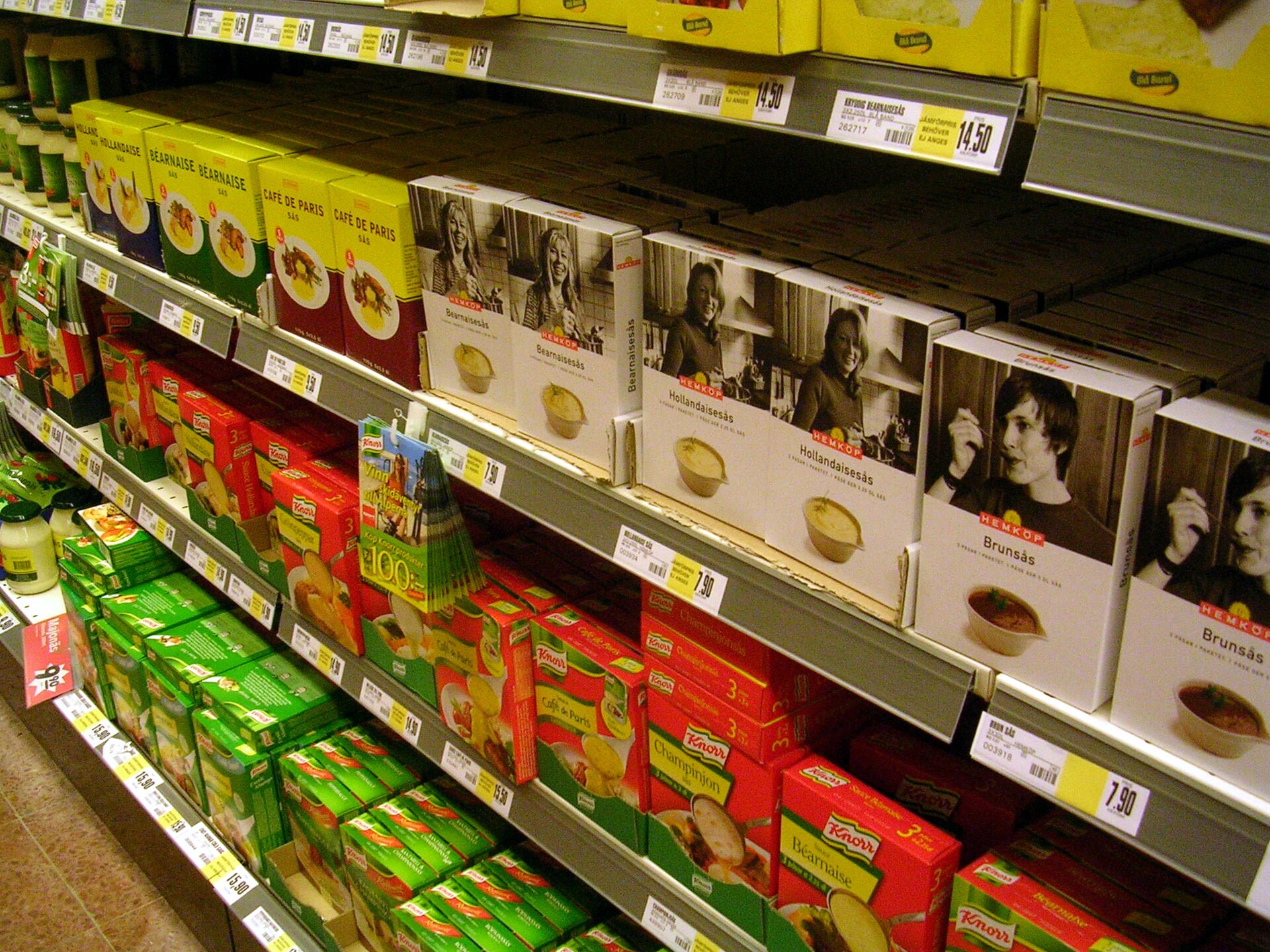
Featured image: Private label products in Swedish Hemköp store by Väsk, via Wikimedia Commons (CC BY-SA 3.0).
Reporting is based on the publicly available sources listed above and has been independently written by Food Tech Insider.