South Korea Opens Shared Food Robot Test Centre in Pohang with NSF Certification Support
South Korea has opened its first dedicated research and testing centre for food robots, aiming to help small companies and startups bring cooking, beverage and serving automation to market faster and secure international certification.
The Ministry of Agriculture, Food and Rural Affairs (MAFRA) inaugurated the Food Robot Food-Tech Research Support Center on 17 September at the Pohang Convergence Technology Industrial Complex in North Gyeongsang Province, The Herald Business reported.
Shared equipment for smaller players
Food robots, which combine AI and robotics to automate cooking, beverage preparation, serving and sanitation, are expensive to develop and test. The Pohang centre is designed to remove that barrier for small and medium-sized enterprises that cannot justify buying specialist equipment.
The facility includes:
- A shared research equipment room with 17 types of advanced devices covering functions such as stir-frying, deep-frying, noodle cooking, drink preparation and serving.
- A “living lab” shared kitchen where prototypes can be tested in realistic cooking environments.
- Startup office space and a co-working area.
- An international standards certification testing laboratory.
A route to overseas certification
A distinctive feature is support for export readiness. The centre has installed testing and certification equipment from NSF, the U.S.-based public health and safety organisation whose standards are widely required for commercial food equipment in North America.
MAFRA aims to develop Pohang into Asia’s first food robot certification support hub, offering companies integrated assistance from technical consulting through to certification. For Korean robotics firms targeting U.S. restaurant chains, certification has been a significant source of cost and delay.
Building on a regional robotics cluster
The location was chosen to leverage Pohang’s existing research base. Pohang University of Science and Technology (POSTECH) has run a ministry-backed food-tech graduate programme since 2024, training food robot specialists drawn from the existing food industry workforce.
The Korea Institute of Robotics and Technology Convergence will contribute smart kitchen models and robot operation technology, while the Pohang Institute of Metal Industry Advancement and Gyeongbuk Technopark will support materials analysis and commercialisation. The centre also plans to work with local companies including Neuromeka, Graphene Square, Polaris3D and Beyond Honeycomb.
First of ten sector centres
Pohang is the first completed site among research support centres the ministry is building across ten core food-tech sectors. By 2030, MAFRA plans to open centres covering areas such as plant-based foods, cell-cultured foods, personalised nutrition, 3D food printing and food upcycling.
Kim Jeong-wook, director general for agricultural industry innovation policy at the ministry, described the centre as a model for collaboration between universities, research institutes and industry, and said the government would support the sector through regulatory reform, an innovation fund and specialist training.
Why it matters
Labour shortages and rising wages are pushing restaurant and foodservice operators worldwide to consider automation, but adoption depends on reliable, hygienic and certified equipment. Shared test infrastructure lowers the cost of proving those qualities, potentially accelerating the flow of Korean food robots into export markets.
For international operators and equipment buyers, the initiative signals that South Korea intends to compete seriously in commercial kitchen automation, with government backing for both technology development and the compliance work needed to sell abroad.
Sources & Credits
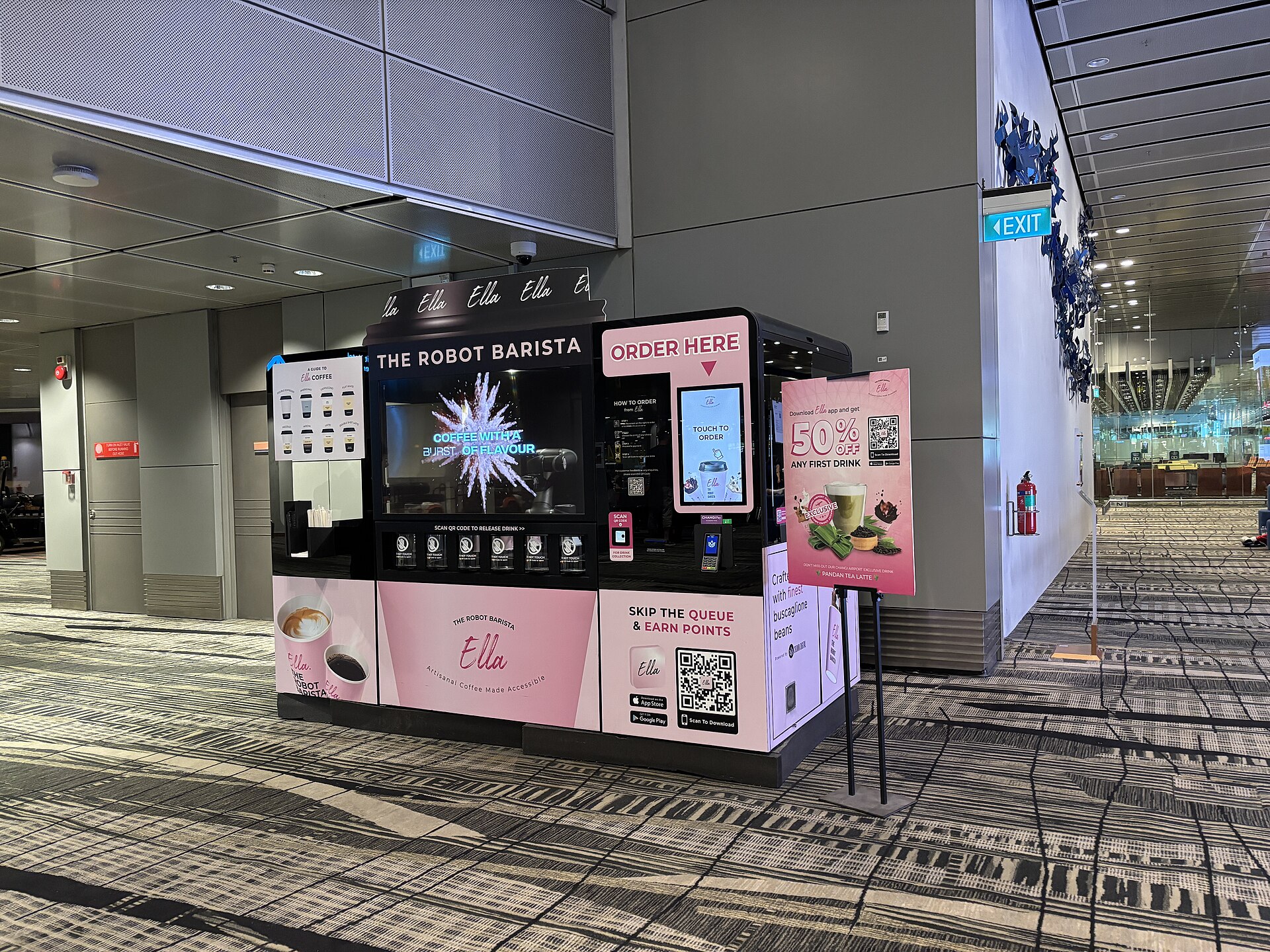
Featured image: Robot barista at Changi Airport Terminal 3 October 2024 by Nick-D, via Wikimedia Commons (CC BY-SA 4.0).
Reporting is based on the publicly available sources listed above and has been independently written by Food Tech Insider.